AI Can Create Content — But It Can’t Create Learning Experiences
Feb 02, 2026
AI has changed how quickly content can be created.
Lessons, outlines, scripts, and ideas can now be generated in minutes instead of weeks. For course creators, this can feel like a relief and a risk at the same time. The tools are powerful, but they also shift the responsibility of what actually matters. When content becomes easy, the real question is no longer how much you create, but how well learners are guided through it.
On the fast lane? Read the summary!
Where AI adds real value
AI excels at speed and pattern recognition. It can help creators move past blank pages and generate material that would otherwise take significant time. These capabilities are useful, but they are not the same as teaching.

Creating first drafts
It helps creators get ideas out of their heads and into a workable format.

Summarizing and organizing information
AI can condense large amounts of material into more manageable pieces.

Generating variations and ideas
It can suggest angles, examples, or explanations that spark direction.
What AI cannot do for learners
Learning is not just exposure to information. It is a process that unfolds over time, with hesitation, momentum, and feedback along the way. AI cannot:
- Decide the right learning order. Only a human designer can determine what needs to come first, what builds on what, and when something should be revisited later.
- Read confusion or hesitation. AI cannot sense when a learner feels lost, overwhelmed, or unsure if they are doing the right thing.
- Create momentum through experience. Momentum comes from pacing, reassurance, and visible progress, not from more material.
These gaps are not flaws. They simply reflect that learning is relational and contextual, not just informational.

Why this matters more now than before
As AI-generated content becomes common, the role of the course creator shifts. Your value is no longer in how much information you can produce, but in how well you guide someone through it. When lessons multiply without direction, students are left to navigate alone, unsure of where to focus or what matters most.
For your students, this shows up as hesitation and second-guessing. They are not lacking motivation. They are waiting for reassurance that they are in the right place and taking the right next step. When everything is available at once, clarity disappears unless you intentionally create it.
Learning improves when students feel accompanied. Your presence, through clear sequencing, thoughtful pacing, and visible guidance, turns content into a path. Structure is how you stay with the learner, even when you are not in the room.
What course creators need to focus on now
THE NEW PRIORITIES FOR COURSE DESIGN
The role of the creator is shifting. Teaching is no longer about producing information. It is about designing an experience that helps people move.

Structure
Clear starting points, intentional sequencing, and layouts that guide attention.

Feedback and Reassurance
Signals that help learners know they are on track and making progress.

Clear Path
Learning experiences that reduce decision-making and support follow-through.

How structure turns content into an experience
Structure is what turns isolated lessons into a learning journey. It shapes how students enter a course, how they move through it, and how they feel along the way.
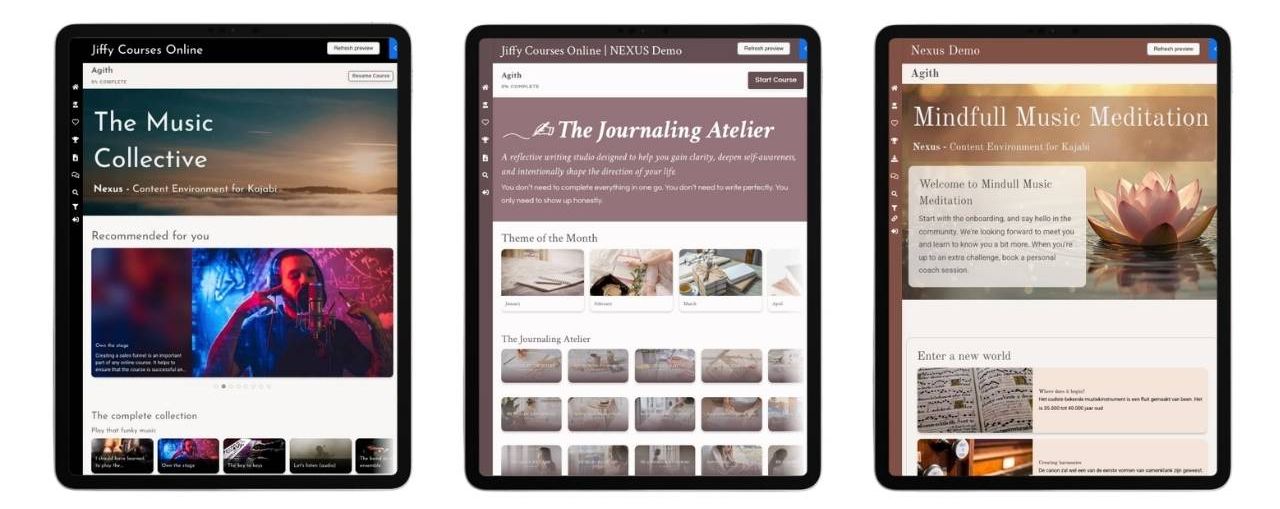
This is also why Jiffy Courses Online approaches Kajabi templates as learning infrastructure, not decoration. Templates are designed to support orientation, progression, and clarity so students understand what to do next without friction.
When structure is intentional, content has space to land.
Beyond structure and guidance, learning becomes stronger when people feel connected. In a world where AI tools are increasingly individual and self-directed, you can create a sense of belonging by giving learners space to reflect together, share experiences, and see that others are on the same path. A community does not need to be mandatory, but when it is thoughtfully integrated, it can provide motivation, reassurance, and human perspective that AI alone cannot offer.
Key Takeaways
- AI makes content faster, but not learning clearer.
- Learning experiences depend on order, pacing, and guidance.
- More content increases the risk of overload without structure.
- Human design decisions matter more in an AI-heavy landscape.
- Structure is what transforms information into learning.
As content becomes abundant, learning experiences become the differentiator.
Students will not remember how much material a course contained. They will remember whether it felt clear, supportive, and doable.
In a future shaped by AI, the most human elements of course design matter the most. Small signals of guidance, like a clear starting point, a visible learning path, or a short onboarding that explains how to move through the course, help students feel oriented rather than overwhelmed.
Clarity, reassurance, and thoughtful structure are no longer extras. They are how you stay present with the learner, and how learning becomes something people can actually follow through on.

Where human guidance still matters most
If AI can help you create faster, the real question becomes how you help people learn better.
That shift does not require reinventing your course or adding more material. It starts with looking at your existing content through the lens of guidance. Where do learners need reassurance? Where do they need a clearer next step? Where does structure reduce effort instead of adding it?
This is the problem Jiffy Courses Online focuses on solving. Our Kajabi templates are designed around learning flow, not content volume, so creators can spend less time organizing and more time guiding. Tools like structured lesson layouts and built-in learning paths help turn information into an experience that feels intentional and human.
You do not need to compete with AI on speed. You already bring something more valuable. You guide people through change.
Frequently Asked Questions
Does using AI reduce the value of a course?
Can AI replace course designers or educators?
Why does structure matter more when content is easy to create?
How can creators improve learning without adding content?